Drone Light Shows
Drone light shows for weddings and events
A choreographed swarm display, with permissions and safety handled.
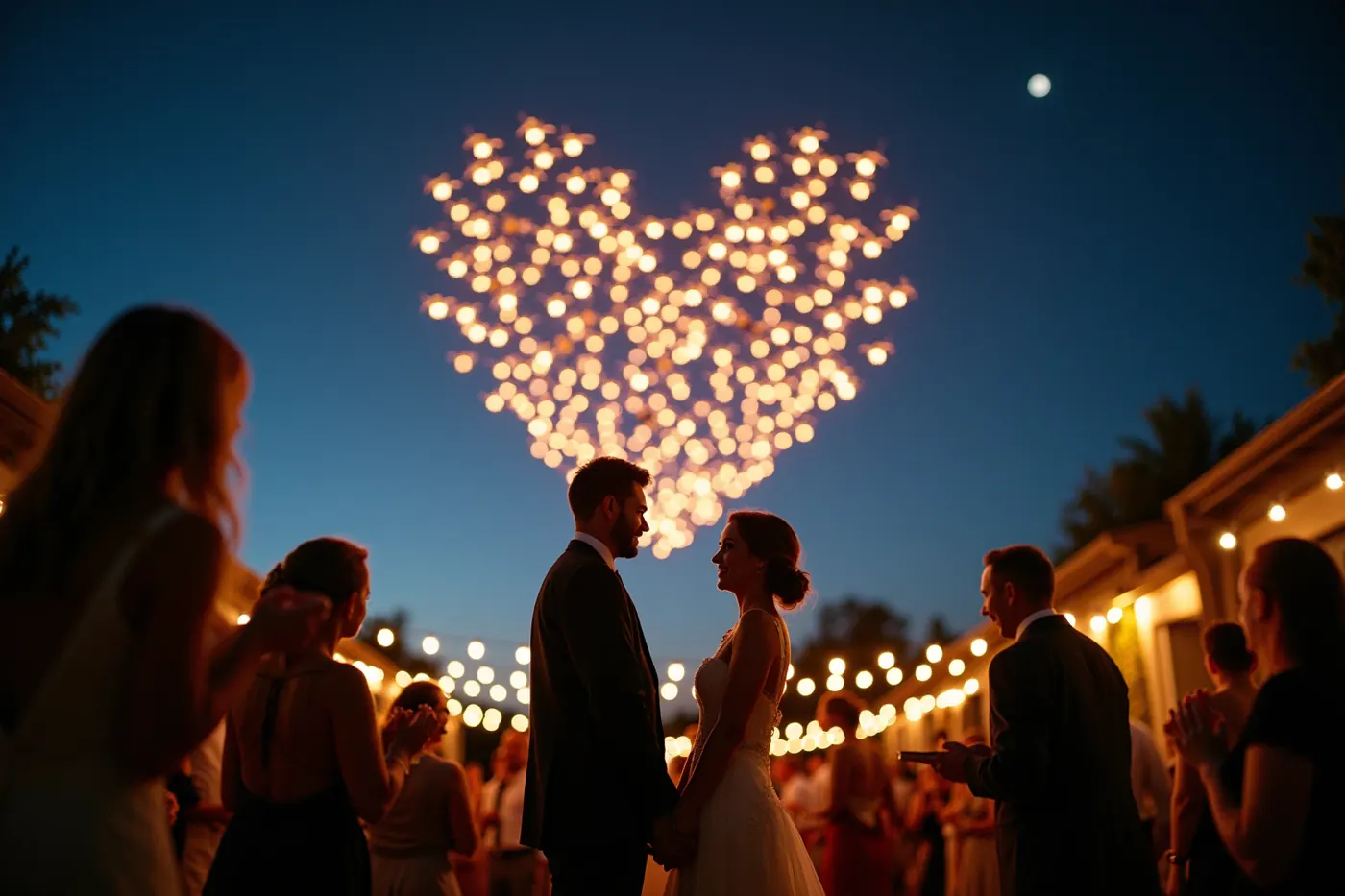
In short
A drone light show replaces fireworks with a swarm of lit drones flying a choreographed pattern, spelling names, dates and motifs in the sky. Flying Pixel Studio designs the sequence to the couple or the brand, secures airspace and venue permission, and runs the display with a safety perimeter and a rehearsed abort procedure.
A drone light show is the only part of a wedding that every single guest watches at the same time. It is also a production rather than a service, with a design phase, a permissions phase and a rehearsal. This page covers how they work, what they need, and what to ask before booking one.
How a drone light show actually works
A drone light show uses a swarm of small aircraft, each carrying a bright programmable light, flying a choreographed routine. Each drone is one pixel. The shapes you see are formed by the positions of hundreds of aircraft holding station in three dimensions.
Every flight path is pre-programmed and simulated before anything leaves the ground. Nobody is flying these manually. The operator's job on the night is to launch, monitor and hold the ability to abort, not to pilot individual aircraft.
The aircraft take off together from a marked grid, fly the sequence, and land back on the grid. A typical show runs eight to twelve minutes, because that is roughly what the batteries allow and, more importantly, roughly as long as a crowd stays genuinely captivated.
One drone, one pixel
Shapes are formed by hundreds of aircraft holding position in three dimensions.
Pre-programmed, not flown
Every path is designed and simulated in advance. Nothing is piloted manually on the night.
Launch grid
The aircraft take off from and return to a marked grid, which needs clear flat ground.
Eight to twelve minutes
Set by battery capacity and by how long a crowd stays genuinely captivated.
What a show can actually display
Names, dates, initials, hearts, rings, religious motifs, company logos and simple animated sequences. The practical limit is resolution: the number of aircraft determines how detailed a shape can be, in the same way pixel count determines an image.
A small show can hold a clear heart, two sets of initials and a date. A larger one can animate between shapes, show a recognisable logo with fine detail, and run a longer narrative sequence. Detailed portraits and small text are outside what any swarm does convincingly.
The sequence is designed to your wedding rather than pulled from a library. That design work is a real part of the timeline, which is why a show cannot be booked the week before, and why anyone offering one at short notice is probably reusing somebody else's sequence.
Names and initials
The most requested element, and one every show size can hold clearly.
Dates and motifs
Wedding dates, hearts, rings and religious symbols all read well.
Logos
Corporate marks work where the shape is reasonably simple. Fine detail needs more aircraft.
Animated sequences
Shapes morphing into each other, which needs a larger swarm and more design time.
Not portraits or small text
Detail beyond a certain point is not achievable with any swarm size.
What a venue needs for a drone show
Open sky and clear ground, in that order. The launch grid needs flat unobstructed ground, and the flight volume above needs to be clear of trees, cables, buildings and anything else the aircraft could contact.
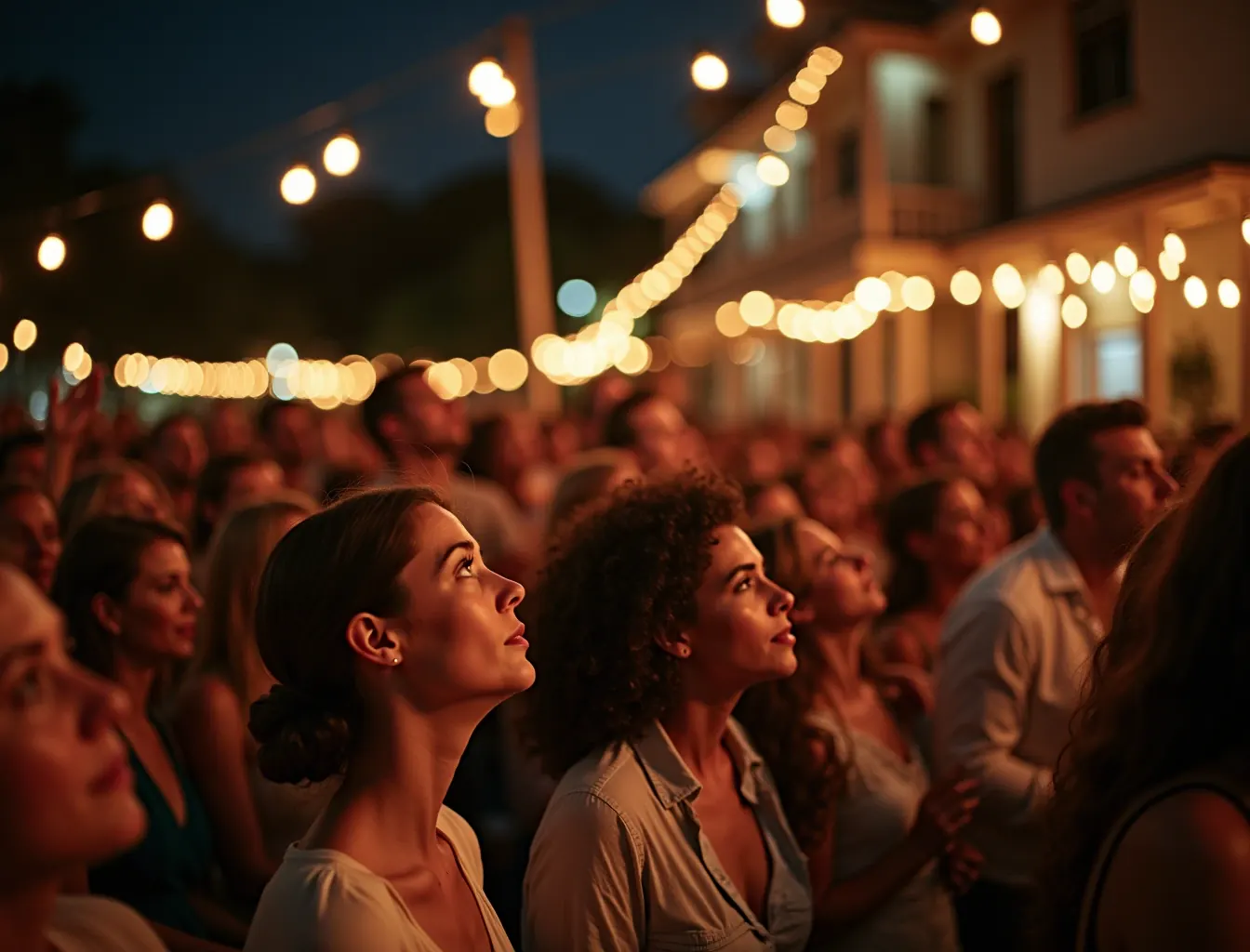
Guests watch from a defined viewing area outside a safety perimeter. This is the part couples underestimate: a show needs the audience in a specific place rather than spread across a venue, which affects how you plan the evening.
Airspace clearance is required and takes longer than for camera drone work, because a swarm operation is assessed differently from a single aircraft. Venues near airports are usually a straight refusal, and that answer is better known months out than weeks out.
Clear launch ground
Flat, unobstructed, and sized to the swarm. A lawn usually works, a courtyard often does not.
Open flight volume
Free of trees, cables and structures through the whole performance envelope.
A defined viewing area
Guests watch from a set place outside the perimeter, which shapes the evening's plan.
Airspace clearance
Assessed differently from single-aircraft work and slower to obtain.
Wind limits
Shows have a hard wind threshold. Above it, the display does not fly.
What drives the cost of a drone show
Swarm size first. The number of aircraft determines what the show can display and is the single largest cost factor, because every aircraft is equipment, battery, transport and a share of the crew's time.
Then duration, sequence complexity, travel to the venue, and permission lead time. A show designed around a bespoke animated sequence takes considerably more design time than one built from names, a date and a heart.
Rush bookings cost more and are sometimes impossible regardless of budget, because permissions have a floor on how fast they can be obtained. The most expensive version of this is booking late and discovering the airspace answer is no.
Swarm size
The biggest factor. Aircraft count sets what the show can display.
Show duration
Longer shows need more batteries and more sequence design.
Sequence complexity
Bespoke animation takes more design time than names, a date and a heart.
Travel
Equipment for a swarm is bulky. Distance from base is a real cost.
Lead time
Rush bookings cost more and are sometimes impossible whatever the budget.
Safety, and the questions worth asking
A swarm of aircraft flying above an audience is an operation with real risk, managed by procedure rather than by hope. Every show we run has a safety perimeter, a marshalled viewing area, a rehearsed abort and a redundancy plan for individual aircraft failures.
Individual aircraft do occasionally fail, and the system is designed for it. A single unit dropping out of a swarm is a missing pixel rather than an incident, and it descends inside the perimeter under its own control rather than falling.
Ask any provider four things: who holds the certification, what the safety perimeter distance is, what the wind abort threshold is, and what happens to your money if the show cannot fly. A provider who cannot answer all four quickly should not be flying above your guests.
Who is certified
Ask for the specific certification held by the operator running your show.
Perimeter distance
There should be a number, and it should be enforced by marshals on the night.
Wind abort threshold
A hard figure decided in advance rather than a judgement call under pressure.
What happens if it cannot fly
Agreed in writing before booking, not negotiated on the night.
Aircraft redundancy
A failing unit should be a missing pixel that lands under control, not an incident.
Where a show fits in the evening
After dark, and after dinner has started rather than before it. A show needs genuine darkness to read properly, which in most of India means at least forty-five minutes after sunset, and later in summer.
The best slot is usually between the main course and the cake, when everyone is present, seated and fed. Running it early means guests are still arriving; running it late means half the room has left and the couple are exhausted.
Build ten minutes of buffer around it. Guests need to be moved to the viewing area and settled, and that always takes longer than planned. A show that starts while people are still walking loses its opening, which is the part that makes the room gasp.
At least forty-five minutes after sunset
Genuine darkness. Twilight washes out the display.
Between main course and cake
Everyone present, seated and fed, which is when a crowd is most receptive.
Ten minutes of buffer
Moving guests to the viewing area always takes longer than planned.
Filmed separately
The show is a moving-image subject. We film it as well as photograph it.
Drone shows for corporate events
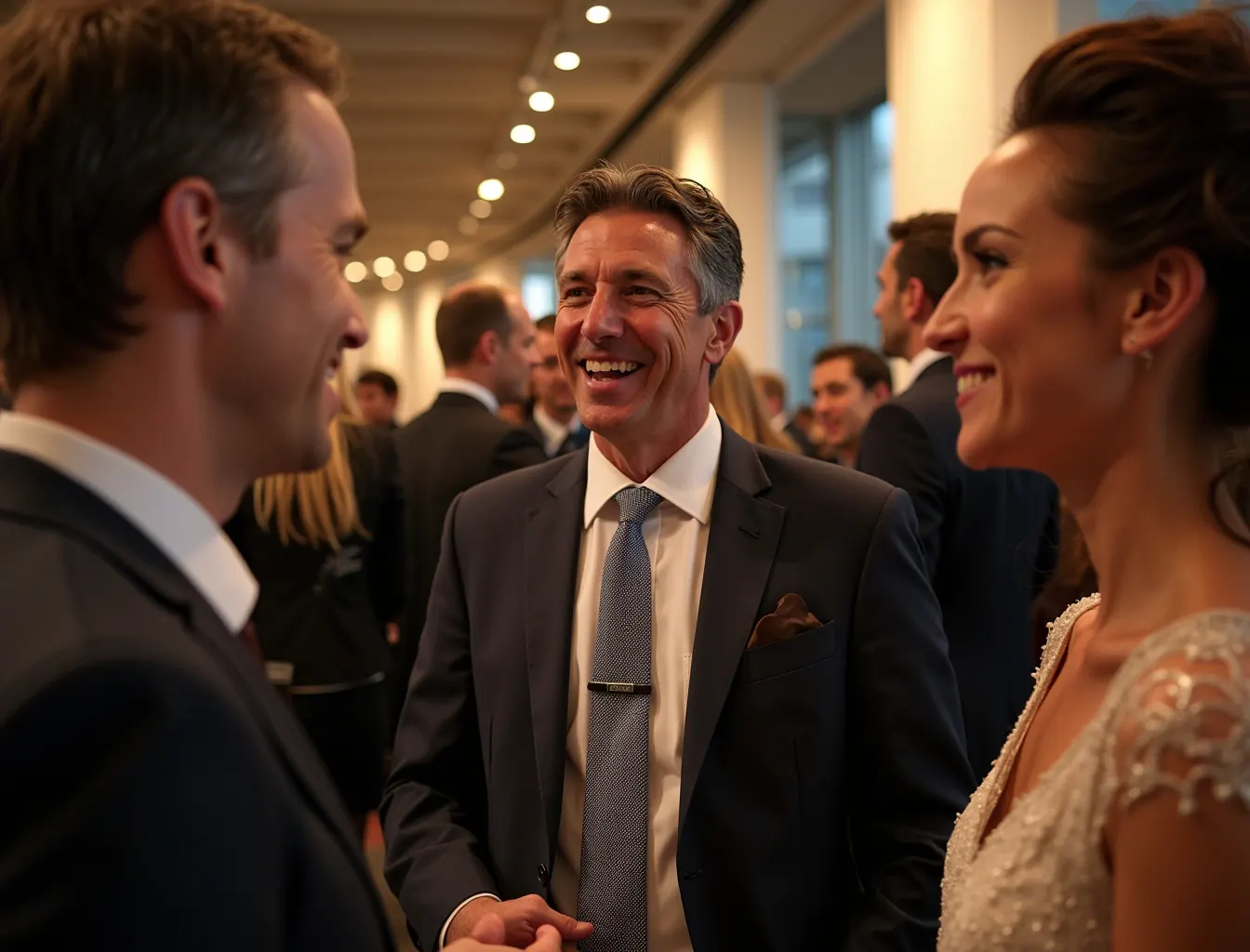
The same production, with different content and a different approval chain. Product launches, anniversaries, stadium events and city celebrations all use swarms, and the design work shifts from names and hearts to logos, taglines and brand shapes.
Corporate shows usually need more lead time, not because the flying differs but because sign-off does. A brand mark has to be approved, rendered as a flight pattern, simulated and then signed off again, and that loop runs through people rather than aircraft.
Public events add crowd management on a different scale. A wedding perimeter marshals a few hundred guests who are seated; a public show may need to manage thousands who are not, and that is a joint plan with the venue and often with local authorities.
Logos and brand shapes
Simple marks read well. Fine detail needs a larger swarm.
Longer approval loop
Brand sign-off, pattern rendering and simulation each take a cycle.
Public crowd management
Planned jointly with the venue and often with local authorities.
Filmed for reuse
Corporate shows are usually filmed specifically for campaign use afterwards.
Checking availability for your date?
Tell us the date, the city and which functions you want covered. We reply within one business day with availability and what a package for it looks like.
What different swarm sizes can display
Aircraft count works like pixel count. This is roughly what each scale can hold clearly, and what it cannot.
| Scale | Typically displays | Reads well at | Not achievable |
|---|---|---|---|
| Small swarm | A heart, initials, a date, simple static shapes | An intimate venue lawn | Animation, logos with fine detail |
| Medium swarm | Names in full, rings, religious motifs, simple morphs | A hotel lawn or resort ground | Detailed logos, text beyond a few characters |
| Large swarm | Animated sequences, recognisable logos, narrative | A large open venue or stadium | Portraits, paragraphs of text |
| Lead time | Weeks, driven by permissions | Longer for restricted airspace | Same-week booking |
| Filmed | Yes, as a separate deliverable | Photographed and filmed | Guest phone footage is not a substitute |
Where we shoot
Flying Pixel Studio shoots across India and travels for destination weddings. Travel and accommodation for out-of-city work is quoted separately and agreed in writing before booking, so it never appears as a surprise line afterwards.
- Mumbai
- Delhi NCR
- Bengaluru
- Hyderabad
- Pune
- Ahmedabad
- Chennai
- Kolkata
- Jaipur
- Udaipur
- Goa
- Surat
Destination weddings shot in:
- Thailand
- Dubai
- United States
- United Kingdom
- Europe
- Australia
- Singapore
- Japan
FAQ
Drone Light Shows: questions couples actually ask
If your question is not here, ask it in the enquiry form and a surveyor will answer it.
What is a drone show?
A drone light show is a swarm of small aircraft, each carrying a programmable light, flying a pre-programmed choreographed routine. Each drone acts as one pixel, and the shapes you see are formed by hundreds of aircraft holding position in three dimensions. A typical show runs eight to twelve minutes.
How do drone shows work?
Every flight path is designed and simulated before anything leaves the ground. The aircraft launch together from a marked grid, fly the programmed sequence, and land back on it. Nobody pilots individual drones on the night: the operator launches, monitors and holds the ability to abort the whole display.
How much does a drone show cost in India?
Our shows start at ₹8 lakh for an eight to twelve minute display flown with roughly seventy-five to eighty drones. Travel and accommodation for the crew are over and above that, as are any venue or airspace fees. Swarm size is the main thing that moves the figure, because every aircraft is equipment, battery, transport and a share of crew time.
How much does a 20 minute drone show cost?
Twenty minutes is longer than most shows run and worth questioning before pricing it. Battery capacity and audience attention both point to eight to twelve minutes, which is what our shows from ₹8 lakh cover. A twenty-minute display means multiple battery sets and a larger crew, so it costs more than proportionally, and audiences disengage well before it ends.
How long is a typical drone show?
Eight to twelve minutes. That is set by two things: what the batteries allow on a single flight, and how long a crowd stays genuinely captivated. Shows longer than that tend to lose the room in the final third, which is why we design to this length rather than to a bigger number.
What can a drone show display?
Names, dates, initials, hearts, rings, religious motifs, company logos and simple animated sequences. The limit is resolution: aircraft count determines detail the way pixel count determines an image. Detailed portraits and small text are not achievable convincingly at any swarm size, and providers claiming otherwise are overselling.
How far in advance do I need to book a drone show?
Weeks rather than days, and the constraint is permissions rather than availability. Airspace clearance for a swarm is assessed differently from single-aircraft work and takes longer. Sequence design also needs a cycle of drafting, simulation and approval. Anyone offering a bespoke show at a week's notice is likely reusing an existing sequence.
What does the venue need for a drone show?
Flat unobstructed ground for the launch grid, open sky above the whole performance envelope free of trees and cables, and room for a safety perimeter with guests watching from a defined area outside it. A hotel lawn usually works. A courtyard surrounded by buildings usually does not.
Is a drone show safe over guests?
It is managed by procedure rather than hope. There is a marshalled safety perimeter, a defined viewing area, a rehearsed abort and redundancy for individual aircraft failures. A single unit dropping out of a swarm is a missing pixel that descends under control inside the perimeter rather than an incident.
What happens if the weather stops the show?
Shows have a hard wind abort threshold decided in advance rather than a judgement call under pressure on the night. What happens to your booking if it cannot fly should be written into the agreement before you sign, not negotiated at the venue. Ask any provider this question early.
Can a drone show replace fireworks?
For most venues, yes, and increasingly it does. A show produces no smoke, no fallout and far less noise, which matters at venues with residential neighbours or animal welfare concerns. It also displays your names and date, which fireworks cannot. The trade is that it needs darkness and clear airspace.
When in the evening should the show happen?
At least forty-five minutes after sunset for genuine darkness, and usually between the main course and the cake, when everyone is present, seated and fed. Build ten minutes of buffer for moving guests to the viewing area, because that always takes longer than planned.
Do you film the drone show?
Yes, and it needs filming rather than only photographing. A show is a moving-image subject with timing and music, and stills alone do not convey it. We film it as a separate deliverable and also photograph the crowd watching, which is often the better set of images.
Can we have a drone show at an indoor venue?
No. Swarm shows need open sky, a clear flight volume and a safety perimeter, none of which exist indoors. Anyone offering an indoor swarm display is describing something different, usually a small number of aircraft in a controlled space, which is not the same product.
Are drone shows allowed everywhere in India?
No, and this is the first thing to check. Airspace restrictions rule out many venues, particularly those near airports, government installations and some heritage sites. The answer is entirely venue-specific and is far better established months out than weeks out. We check and confirm before taking a booking rather than after.
Can you show our names and wedding date in the sky?
Yes, and it is the most requested element. Names, initials and dates read clearly at every swarm size. The design is built for your wedding specifically rather than pulled from a library, which is part of why the lead time exists and why a bespoke show cannot be arranged at short notice.
Do drone shows work for corporate events?
Yes, with the same production and different content. Product launches, anniversaries and city events use swarms regularly, with the design shifting to logos, taglines and brand shapes. Corporate shows usually need longer lead time, because brand sign-off, pattern rendering and simulation each take a cycle through approvals.
How many drones are in a show?
A show at our ₹8 lakh starting point flies roughly seventy-five to eighty aircraft, which holds a heart, initials and a date clearly. Larger swarms animate between shapes and can render a recognisable logo. Aircraft count is the main cost driver, so we size the swarm to what you want it to display rather than selling you a number.
Is a drone show the same as aerial videography?
No, and confusing the two is the most common misunderstanding in this part of the market. Aerial videography is one camera aircraft filming your wedding for your film. A drone show is a swarm of lit aircraft performing for your guests to watch live. Different crews, permissions and budgets.
Can guests take photos of the show?
Of course, and they will. It is worth knowing that phone footage of a drone show is consistently disappointing, because phone cameras struggle with small bright points against a black sky. That is why we film it properly, and why the film is usually the only good record anyone ends up with.
Other things we cover
- Wedding Photography Candid coverage and a cinematic film of the whole wedding, from one crew.
- Pre-Wedding Shoot A planned shoot on a location that suits the two of you, not a template.
- Mehndi, Haldi & Sangeet Full coverage of the functions, not just the wedding day itself.
- Maternity & Newborn Calm sessions worked around the baby, at home or in the studio.